Showing posts with label Reflections on Class Learnings. Show all posts

Thursday, December 4, 2014

My Final Blog Post... For This Class... But Not Forever...


What does it mean to be connected? What are the benefits of being connected? Why would educators want to be connected?

I have found myself trying to convince educators on the benefits of being connected for the past couple months. It’s not necessarily about being connected to the level we have been in this class. It’s about being connected so that there is an opportunity to explore the best practice and ideas of other teachers around the world. A couple years ago, when I went on Twitter and starting following Twitter educators and EdTech “Gurus”, I started to find that I came out of my “bubble”. The bubble or that network of teachers that one might interact with within their school or their division.

Being engaged in Twitter gave me a chance to talk about education. It gave me a space to converse about the "stuff" I'm interested in, without talking off the ears of my non-teacher friends. Now don't get me wrong, I love collaborating face to face and discussion education. But how often do we actually get that opportunity?Once or twice a month? And even that might be a stretch! So rather than complaining that there is never enough time to collaborate, I found my space in Twitter to do exactly that. A teacher no longer has to wait for a convention or an inservice… the answers can be found in your own PLN via Twitter or in a community like Google+. Others might suggest that many answers can be found reading a book.Read a book? No way, that’s just one person’s perspective. (Actually I'm just kidding, remember I was a Teacher Librarian for a short stint). In reality, by going on-line, a person’s education become not just a selection of reading, but a multimedia digital inservice with videos, podcasts or even communities like the one we engage in.  You know there should actually be a poster... “Take back your own professional development…Don't wait for that inservice... Explore digital spaces to educate yourself!”

Okay, that’s enough ranting… As I mentioned in a previousblog post, I had a chance to present at a Teacher Librarian “EdCamp”. It wasn’t really an EdCamp as all the presenters were kind of prechosen based on a questionnaire sent out. But anyways, it was a start. At the EdCamp, I presented sessions that relate to this class and the point of being a connected educator. My sessions included: MOOCs and Digital PD, Battle of the Books Goes Digital, and Genius Hour. All the sessions went really well. The session that surprised me the most was the excitement over the MOOCs and digital PD. Teacher Librarians were really excited to learn about MOOCs. Many were amazed that universities like Stanford and MIT were offering courses. They were also excited by the number and variety of courses offered through Coursera and Canvas. And many were shocked to learn that they were FREE! As I was presenting and getting the Teacher Librarians to peruse the classes, many started saying, “I’m going to sign up for that one” or “That’s too bad, it’s already started”. Of course a majority of teachers had never heard of MOOCs but this definitely did not suppress their enthusiasm.

After the MOOCs part of the session, teachers started to explore Twitter and the tweets from the “Teacher Librarian Gurus” and “EdTech Gurus”. Intially they thought that Twitter was like Facebook, until I helped them explore my Twitter profile. And I explained who I followed and why (not all 400+), but my top 15. Then people started to get it when they saw the tweets. It became apparent that by being engaged in Twitter I was learning about what was innovative. No longer did I have to wait for some consultant or coach, like myself ;-), to tell me what was new and worth trying out. I was finding out first hand right from the “Gurus” themselves. And what was cool, I could even tweet at these individuals and ask questions. As we explored, many lightbulbs went on. Teachers were starting to see how being connected could make a difference in teaching, and that by being connected, I wasn’t chatting about trivial stuff as what often comes up when on Facebook, I was developing my own Professional Learning Network and it was with those people of whom I wanted to hear their ideas.

Now that’s not the end of my story… sorry, I know I tend to go on and on… That EdCamp was a month ago. Now I’m starting to hear from teachers that they’re learning about Genius Hour, Mystery Skype and Flatclassroom. But the best part is… They are also talking about their Digital PD and “this thing called a MOOC”. The part about this story that I find inspiring, is that many of these teachers heard about these opportunities from their Teacher Librarian. Interestingly enough, and this is worth noting… their TL reached them via Face to Face staff meetings, yet now they are excited about the opportunities to connect digitally. How cool is that???


I’m not sure I have more to add to this last blog post, I will continue to add to this blog. I might have to change up the categories, as I won’t have a “Class Reflection” but I like sharing what’s hot and my perspective on it, or how I would use that tool in the classroom to extend learning. I will also post to the blog roll of my Major Project Website the Teaching With Technology Hub, but in that space it wont be the same. I’m excited to say that my "Hub" with some of my ideas such as sharing “Classroom Digital Stories” (Genius Hour, Blogging and Mystery Skype) is going to be presented at a RCSD Board Meeting in January. (And yes, I'm excited, yet nervous!!!) So I’m a bit torn. This is great, but I feel as though when I blog in that space it will be different than in this space...  In the Teaching With Technology site  I “represent” the division. I will have a “Dual Digital Identity” in some ways. I won’t be able to really state my thoughts without being a little political. In any case, I don't mean to sound negative, I'm actually excited that the site is gathering enthusiasm. Although the "hub" is a website and blog rolled into one, I think that this will still suite the needs of my division. The blog roll will allow me to share the latest "digital story" or project idea, but the website will offer an organized layout to share those ideas. So thank you Katia for sharing this advice in thinking of ways of making it more collaborative. You're right, I needed a space to connect with teachers and offer opportunities for their input. Now I just hope that people will actually comment...

Overall this class has helped me consider how I can have the most impact in helping teachers in my division find ways to connect and explore ways to make their students' learning visible. 

Monday, November 24, 2014

How Do We Teach Empathy and Resiliency Online?

Harassment is Not New... It's Just a New Space for the Jerks


I was talking to my dad recently about school and bullying issues. My somewhat redneck dad had a simple solution to bullying and that was, "Just let kids (he most likely meant boys) be kids, and wrestle it out on the playground, and it will be finished." At first I kind of laughed. Imagine if we just let kids "duke out their problems". Ridiculous... But was there some truth to that? Did kids in our parent's and grandparent's generation, just deal with their issues right away without letting it drag on? There were the bullies and the "intimidators" in their time, but did they have the power they do now, by being able to present a constant threat to those pegged as their victims? Has technology allowed harassment to become more of a mental and emotional issue than in previous generations?  Hmmm... I thought there was maybe some truth to my dad's way of dealing with issues, until I read Tammy's post, "Speaking from my spot in the corner... let the over-sharing begin!"  After reading about her struggles to become an independent and confident person, while dealing with negative pressures of her father, it only reinforced to me, that women being harassed or encouraged to be quiet is not a new thing, it's always been around. Were things really dealt with in our parent or grandparent's generation?

My Thoughts on Being a Woman Online

Photo Credit: Stefan Mendelsohn via Compfight cc  
As Benita pointed out in her blog post, "Women" or Ryan explored in his post, "If You Don't Like What They are Saying, Change the Conversation" our session with Audrey Watters wasn't really that shocking. Yes, it is unfortunate, that I many of us weren't really shocked to hear that women are demeaned and harassed online. It wasn't shocking to hear that when a women speaks out about an issue that immediately she is harassed into silence. It wasn't shocking that there are individuals who take it to the extremes to psychologically threaten others, so that they can't even go online just because they spoke their opinion.  In her post, Benita states, "So here we are in year 2014 and along with the issues in advertising we have to contend with the technology age and not being (portrayed) as smart enough, not being able to give our opinion, don’t play online games (or do well) and so on…" I have to agree with her comments, not a lot has changed. Women continue to be threatened if they put themselves out there too much. The only thing that has changed is the environment, and unfortunately it's an environment that in many ways is still the Wild West or Uncharted Waters. 

Recently when I put my about.me picture on my profile, I started to wonder if a pic with my daughter was a wise choice. I started to wonder about the environment and the insidious nature that the Internet offers for those who wish to do harm. Nowhere in my photo does it say that I'm with my daughter, but a shadow started to creep into the back of my mind, as I started getting updates on who was checking out my about.me profile. Thankfully most of those who looked at my profile were members of this class, but there was the odd person who had no connection to education or technology, or even sports. I started to rethink the links I had posted from my Google+ information to my Twitter profile. I'm usually pretty savvy about the image and information I put out there to the world, and for the most part, I'm sure no one cares. But what if? What if I caught the attention of some creep?  Regina just isn't that big. Now after our talk with Audrey, I wonder if I should change my profile picture. Should I be this paranoid? 


It's Everyone's Deal


As I was exploring sites related to online harassment, I stumbled upon a Time article, "Misogynist Online Abuse Is Everyone's Problem - Men Included" written by James Poniewozik. In the article,Poniewozik,  shares this point, "the price of having a female byline and an opinion is getting subjected to torrents of gender-specific, grotesque, sometimes frightening and threatening abuse, which men like me, in general, do not deal with to nearly the same degree." This definitely reinforces our discussion with Audrey... But the part of his article that really captured my interest was his reasons for saying why the misogynist abuse is everyone's concern.


"It’s still my problem, though. There’s a whole genre of men saying that they’ve become feminist because they have daughters. I don’t; I have two sons. Which is exactly why this kind of toxic crap in the culture is my problem, because they play games and they live in the world, and I want them to grow up to be decent guys with healthy human relationships. I don’t want them immersed in a mindset that says that throwing anonymous abuse at women is somehow retaliation in kind."

I think as teachers we need to kind of embrace this philosophy, that teaching for these kinds of issues is more than just a few lessons in Digital Citizenship.It's more than teaching girls to be confident and stand up for what they believe. The issue is not just a digital one.  It's about teaching kids about stereotypes and generally about how to behave, even if you don't agree with another person's opinion. Unfortunately as doors open and walls were flattened with the Internet, it has become a bit harder to keep the trolls from coming into our domain.


Moving Forward, Even When You Wonder If It's Worth It


So where do we go from here? I agree with Tammy's advice at the end of her post, in that we "don" our life jackets and teach students how to avoid "the rapids, the submerged objects, the sand bars" and sharks. And, in going with her boating metaphor, we teach students to be more than wandering sailors unsure of the waters ahead, and instead become wise, confident captains of their own journeys. This means empowering kids. Teaching boys and girls that online harassment is something we can't be silent about, and that it's worthwhile to speak out against "toxic crap" in our culture. We probably won't solve all the issues related to being online, but we can do our part, which is, do what we do as teachers... educate kids and make them ready for anything.


So....

I leave with one question... Should I still change my profile pic? Or should I just be aware and keep it as is?? Thoughts anyone??


Tuesday, November 11, 2014

What Tool Should We Use to Tell a Tale?


+Andrea Needer asked our ECI 831 Community, what tool teachers like to use for Digital Storytelling. I too had been pondering that exact question, especially since there are so many tools to choose from. During our discussion with Alan Levine @CogDog, I wondered what would the "Master Digital Storytelling Guru" recommend for telling a tale? Aside from suggesting that perhaps I check out his site and take a look at what's available, he didn't offer any outright recommendations to his favorites. And now I can see why....


Photo Credit: EAWB via Compfightcc
Interestingly enough just prior to our discussion with Alan, I had a teacher inquire about sharing a retelling project that she had been working on with the story, The Waltz of the Scarecrows. In her project she had the students create a retelling/ re-enactment of the tale, by having the students dress up and portray the events and the emotions of the story. Her project centered around the question, "How did scarecrows come to be?" or "Why do we have scarecrows?" After taking several photos, of the grade one students retelling and acting out tableaus for the story, she had asked how could she share this project with parents. She was familiar with using digital tools but wasn't sure what would be the best to produce this story prior to reportcards... Yes, she wanted to do a digital story prior to reportcards and conferences and still be sane enough to teach her busy grade one students!

Prior to our discussion, I told her that I needed to know what devices and programs she was able to access, and how much work was she willing to put into to learning the project. At first she wanted tons of "wow factor", which made me wonder if we were going to be creating a blockbuster digital story - and how much time did she think that we really had? Finally, I pondered, if we went with lots of flash, would the story be lost in the digital tools? Hmmm...

Danielle Degelman pointed out in her post, "Once Upon a Digital Story", that "Digital storytelling presents an exciting opportunity for students to share personal stories and create fictional stories that respond to various genres." That was it. Giving the students the opportunity to share their story or retelling. Was there a danger of losing the students' voice and their retelling of the Waltz of the Scarecrows with the tools, or was I coping out? Was it best to go with a tool that we knew and  could use well, or go for something that would allow us to hyper-edit and produce the story into something "shiny"? I had questions that needed to be answered.

So, last Tuesday, I attentively listened to Cogdog's wise words on how student voices can be unleashed with digital stories. The potential became evident in how digital stories can fully engage students in all aspects of the strands in English Language Arts through activities like the improvised Pecha Kucha or Pecha Flickr. Eagerly I waited to hear what tool he thought it would best for a digital storytelling project, allowing me to then share this wisdom with my friend. Maybe our question regarding what was the BEST TOOL for her scarecrow story would be answered... Yayyyyy! And... fist... System Overload.... My brain melted.  He provided not just one answer but  a blog, a wiki,  and another wiki's worth. Sigh... Thanks. Back to square one, and now I'm left with a puddle of a brain...and tons of resources to explore.

Photo Credit: Spamily via Compfightcc
Today, my friend and I discussed what tools would be best... again. We came to conclusion that it's not the tool, it's the story you want to share... (It's funny how I keep coming to this conclusion). We revisited her outcomes and what she hoped to achieve in the project. These outcomes were to explore the "big" or essential question, re-tell a story from a student's perspective and to act out these events. So what did we decide to do? What was easy and accessible for her? We decided to use Animoto to create a "trailer" for the project, using photos and video that she had captured with her phone incorporating questions and student retellings in simple form. I showed her how to use Animoto, which by the way was with my upgraded personal account (worth the price by the way). After I showed my friend how to navigate through Animoto, she was on her way. The next question was how to share the video. I suggested uploading it to Youtube, but keep the privacy settings on non-searchable and private, so only those of whom she shares the link will be able to access the video.

We later started to build her story in Photostory, which again is very easy to use. She will be able to later share these stories with parents when she compresses the story to a video file so that it can be seen with a Windows Video File... I think... This might be something that I need to explore, does anyone have more experience with Photostory regarding sharing?? I suppose that will require more research on my part.

If you are still not sure whether or not you should upgrade your Animoto account and if it's worth the price, check out Krista Gates blog post, "What's the story?", where she also promotes using Animoto.


Tuesday, November 4, 2014

Embellishing Reality & Improvising the Truth with Digital Storytelling

TED Talk to watch

What does it mean to tell a story through visuals? What power do comics have in telling a story? McCloud a comicbook artist, explores his journey and philosophy as a comicbook artist. He examines symbolism, visual iconography and the role of vision in the artistry of comicbooks. He explains the art of storytelling, using images in digital storytelling mode with pictures. He discusses what does it mean to have vision and the 3 components that make up vision: the unscene or the unknowable; what can be proven or the tangible; or the unproven. He also explores what does it mean to have vision? What are the principles of vision? In the talk he share these four principles of vision, which are:
1) Learn from Everyone
2) Follow No one
3) Watch for Patterns
4)Work Like Hell

*Tips that we can all live by!
For comicbook artists there are four ways of looking at the world in four main comic book types:
1) the Classicist
2) the Formalist
3) the Aimist
4) the Iconclast
Throughout the discussion he examines how the comicbook artist makes a story come alive by activating all our senses. It made me realize all the components that went into making a comic, it's more than being a great artist with an eye for detail and a lingering sense nostalgia for this literary form. McCloud explores interactivity and hypertext in comics and "comics of the ancient world" and how comics can explore space and time the way information is shared. Huh?? He examines how comics could be shared so that the plot or the type of story or tale could be shared in the manner in how the comic is created. For example, a circular story would be shared in a circular manner, so that the panels were circular.

I love the graphical way he visuals how a story can be told. I immediately connected with Alan Levine's session and how the form for telling the story depends on the story that is being told. So going back to technology... It's all about finding the best tool or the best means to tell that story. Hmmm... It's all making sense now. Be sure to check out this TED talk. Great points to consider in telling one's story!

Here is a link that also includes visuals of Scott McCloud's elements of comicbook storytelling that connect well with digital storytelling. This link is to a presentation, "Digital Storytelling on the Go" created by the SAMR model creator Dr. Ruben Puentedura. I thought the connections between McCloud and Puentedura were pretty cool! Kind of demonstrates the learning that even experts like Puentedura can make from visual pen/paper artists. Storytelling is storytelling - digital or paper.
Now with my own personal applications to digital storytelling...

The Tales of an Unsung Technology Coach...

Here is the first part of a comic that I created using the free version of StoryBoardThat. The free version limits the user to creating comics that allow for only six panels. After some thought on writing a creative story. I gave up on that, and decided to just share some of my experiences in my new role as a Technology Coach. Maybe my creative juices were just tapped out...

Comic created via Storyboard That

After I create my second part of the comic, I'm going to look at narrating the comic with an audio recording uploaded to Soundcloud. How else could I add audio without downloading this image to Explain Everything or Educreations on a tablet. Other ideas?? Vocaroo?? A screencast?? Create a ThinkLink of my comic (screenshot or use Snipping Tool to capture) with embeds of my audio recording?? Hmmm....

How can we make it quick and easy?? I have a MAC which has iMovie and is great for video production, but most teachers don't. So the question I keep asking myself is... How can we make using technology easy for the non-digitally savvy user??? How can we make it all accessible and worthwhile for teachers to learn??

More Questions and Great Resources on Storytelling


In terms of digital storytelling, I have even more questions. So I wonder...
How can we make using the tools easy to tell the story??
What tool is easiest? For photos? Videos? How can we share these stories? 
Is creating a comic telling a story? Should I narrate over it?? What role does that play?? Should I have the speech balloons or thought bubbles??

In addition to the great resources Alan shared with us, I've been looking at resources on Digital Storytelling for primary grades with the work of Shelly Terrell. Shelly has tons of great tools and examines strategies to engage learners and help them tell their story in the blog post article, "Engaging Learners through Digital Storytelling: 40+ Resources & Tips", there is also another article on Edublogs, "20+ Apps to Support the Digital Storytelling Process". She explains some key aspects such as using creative commons images when telling stories which is pretty essential (unless you are a Creative Commons Criminal like myself! ;-) There is also a great link to Kevin Hodgeson's site, StopMotion Movies where he explores the process of storyboarding in creating Stop Motion Projects. He has great process oriented resources to guide teachers and students into great stories that are well planned and executed!

And in addition to the great tools @cogdog shared with us, it's worth one's time to check out this article on tools and digital storytelling  practice suggested in an article by Mindshift, "Ideas for Using iPads for Digital Storytelling" finally, be sure to check out Kathy Schrocks Guide to Everything Blog post on Digital Storytelling where she explore tools, strategies and assessment in making digital storytelling come alive in curricula. What I love it that she also has tons of examples to illustrate the many ways one can tell a story and the different shapes it can take to make the voice of the author heard by the audience.

Another great tool for sharing a story in the form of a journey is from StoryMap JS, which @Raelynn shared from our class. This resource I think would be perfect for telling a story which demonstrates a change in geographical setting. Right away, I envisioned students using this tool in English Language Arts to explore the journey of a character if the plot changes considerably. When I was co-conducting a "Teaching With Technology" session I introduced it to a teacher who was going to be using the Seven Series of books in Book Clubs with his grade 8 class. Immediately I thought as part of the unit, one could explore the geographical plot changes in the book and the emotional journey of a character as he partakes in the adventure to do the bidding of his deceased grandfather. By writing a storymap in this form, students could write the journey, then narrate it from the perspective of a character.

Here is a fan-made book trailer created by a student who loved the book, Between Heaven and Earth by Eric Walters. Creating book trailers could be a form of Digital Storytelling to get other peers enticed to read a book. This one I believe was made with the iMovie app.

Be sure to check out the resources above and the TED talk.

Stay tuned for more on my comic, "The Tale of the Unsung Technology Coach" - I will add more to this post with part 2 of my comic, which might become one of the aspects of my own Summary of Learning. Thoughts anyone??

Friday, October 24, 2014

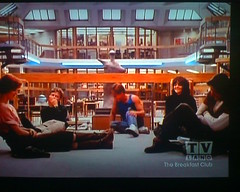
"The Breakfast Club", Being Connected and Digital Identity

the library by MacQ, on Flickr
Creative Commons Creative Commons Attribution-Noncommercial-No Derivative Works 2.0 Generic License   by  MacQ 

 
When we were in school, particularly as teens, we wrestled with our identity based on how we dressed, what we did for fun, or who we hung out with. In the movie, "The Breakfast Club", teen identity was tightly wrapped up in one's peers or social group. How has this changed today?  As teens, many of us were able to relate to at least one of the archetype characters in "The Breakfast Club". Even if the characters represented stereotypical teen cliques, the movie explored the idea that each of these individuals was more than the stereotype of the group they hung out with. How have the roles of teens today changed from the roles of this  well-loved teen classic?  On-line are there still "the jocks", "the brains", "the princesses" "the basket-cases", and "the criminals"...? Do those names still linger? Or have they morphed into something else?

As teens 20 years ago, trying to forge an identity with social pressures was challenging enough. It was time when one could perhaps be themselves, without the eyes of peers constantly "watching". Today with social media, do teens have more or less freedom to be themselves? Is the presence of the "ever-present" social media changing the way kids form their identity?  Or is there a greater challenge in trying to create that online identity and be true to their offline identity?

In "The Breakfast Club" we see the effects of stereotyping and bullying, which seem to be somewhat overcome by an afternoon of detention which opened the social boundaries that separated the teens. In today's terms how have the roles changed? In the on-line world, what are the new roles? Could they be the: "Citizens", "Trolls", "Victims", "Hackers", "Users", "Creators", "Tweeters",  and "Curators" ... (I'm sure there are more, these are just a few I could think of.) But how are these roles changing the formation of this identity? Are the Pintrest users the new "Princesses", "Google+" users the new "Brains" and the "Trolls" the "Criminals"? Have things changed that much in 25 years? Are students still categorized by their peer group and how they socially interact. Is it just the location for social interaction the part that has changed? 

A few years ago, I had to intervene with a couple cases of harassment via Facebook with a middle years student. The solution that was decided, was that the student being harassed should "take a break from social media", for their own emotional protection. It was a challenging situation to navigate, because as was pointed out in our discussion with @bonstewart Tuesday night, why does the victim always have to stop socializing via social media? Why not the bully? Seeing the student suffering from the hurtful comments and not really getting a break from it was heartbreaking. What was more challenging, was trying to get the cooperation from the parents of all the students involved to intervene and admit that something had to be done (and not just the parents of the victim). My situation was only a small fraction of the insidious harassment as evident in the Amanda Todd case (CBC Fifth Estate story, "The Sextortion of Amanda Todd"), but nonetheless, one can see how quickly social media can turn ugly, even at a middle years level. It makes you wonder, where is the on-line detention room when you need it?


I suppose this is part of the important role that teachers have in helping students learn how to interact in the online environment. It's not just about teaching students how to use the technology and navigate the digital world, but also recognize ethical and unethical situations when they see them. As parents and teachers we can somewhat control the physical environment that our kids interact within, but when it comes to the on-line environment, we almost need to be as vigilant as we would be walking with a child near a dangerous city street at night! We need to teach our kids how to be safe and protect their identity and how to avoid the "Trolls" looking for ways to steal the joy of socializing on-line.
Going back to "The Breakfast Club", how can we look for spaces (outside of detention) where kids can socialize in this world and really get to know each other? Or is this even necessary?? Should we keep these on-line spaces impersonal and controlled, particularly with younger on-line users??  Or should we look the Internet as a place that will provide a space where social boundaries can be crossed, sort of like in "The Breakfast Club"?

There are so many questions still left unanswered, that I will need to muse on further... 

Reflection Part 2 - Social Media, Curation and Gamerwhat??

North American detail map of Flickr and by Eric Fischer, on Flickr
Creative Commons Creative Commons Attribution 2.0 Generic License   by  Eric Fischer 

This post is an exploration of my reactions to the curation of fabulous resources from our discussion with Bonnie Stewart on Tuesday night. I took a little time to read and reflect on the suggested videos and reading, and here are a few of my reflections....


Twitter Search #YesAllWomen
This hashtag from our discussion, caught my attention, so I checked it out on Twitter to learn more.... It was interesting to see how a hashtag could curate thoughts on promoting the treatment of women or issues that women face. Anyways, it was interesting. Would I tweet to this hashtag? Probably not... as quite honestly, my Twitter Identity is quite wrapped up in educational issues, such as literacy, digital literacy, assessment, youth poverty issues, social activism and youth. Nevertheless, I respect the opportunity that having a hashtag to promote awareness regarding important issues such as female bashing. In the future I would be interested in checking out this hashtag just for interest.

I Liked Everything on Facebook for Two Days, See What it Did to Me - Wired Magazine

Great quote from Wired, "This is a problem much bigger than Facebook. It reminded me of what can go wrong in society, and why we now often talk at each other instead of to each other. We set up our political and social filter bubbles and they reinforce themselves—the things we read and watch have become hyper-niche and cater to our specific interests. We go down rabbit holes of special interests until we’re lost in the queen’s garden, cursing everyone above ground."

I found this article from Wired to be really interesting. I actually hadn't really paid much attention to the issue regarding Facebook controlling the information that was funneled to the user.

The reason I included the quote above from the article regarding talking at each other, is because I have often wondered if we actually read what people post in Facebook or in other communities. As teachers we look at encouraging our students to be readers who are able to effectively interpret, summarize, analyze and synthesize what they read. But do we? Has the focus with Social Media become so much of a sharing space that I wonder if we are actually deeply reading what is shared. Can we really beat ourselves up too much with the breadth and the vast amount of information that we are faced with? As adults are we so inundated, that we have lost the art of reading deeply?? I think that as teachers this is an issue worth considering, as the amount of information that our students are exposed to, isn't going to diminish. Yes we can encourage our students to be contributors to this on-line environment, and as a big fan of blogging in the classroom, I believe we should. But how can we encourage that deep understanding?? I think it goes back to perhaps following the same formula that I like to promote in my room for "Making Quality Comments". (The visual is a poster for a "formula" I created for effective comment writing.)

Then there were all the articles with "Gamergate", which included: "Yes Gamergate is an EdTech Issue" and "Gamergate Controversy". It actually seemed a little bizarre to read about "sociopaths" as described in the "Trouble at the Koolaid Point" article, where Internet "Trolls" are described as going out of their way to make the lives of individuals challenging to unbearable, just for fun. Maybe I'm too busy, so I don't get this concept of an individual taking the time to help create a band of "haters" via social media. I mean, who has the time for ridiculous stuff like that?? I like tweeting and reading other tweets to see what's new in edtech or literacy... but to read someone's negative tweets about another person? Huh?? Who cares? I suppose I would get annoyed if it meant I started losing followers, as it has taken me over 2 years to get 500+ followers. But at the same time, I don't think that my followers are the type of Twitter users to really pay attention to this type of negative content.


However, if there were "Trolls" going out of their way to threaten me or my family, as in the case from the "Yes Gamergate is an EdTech Issue" I would probably just drop Social Media. It wouldn't be worth continuing. Even if a Troll isn't emotionally invested in bullying and is just doing it as a sick social experiment, I think if you just drop Social Media, you're not letting that person get to you.


Speaking of Trolls...


I feel like a bit of an Internet Stalker...I know I'm probably not, but after exploring "Internet Trolls" I don't want to be associated with any of that behavior. Moving on...

To learn more about Bonnie Stewart and her work, I Googled her... of course... and came across this Youtube video. It's on the Social Contract and the MOOC. I found it interesting how she explores the social interaction of the learner, whether it's with a text or with the MOOC community. Very interesting comments on connectivists, MOOCs, and the expectations of the learner and their expectations of the social contract and the MOOC.


The Youtube video has the following descriptor, "how do MOOCs - across the spectrum of xMOOC to cMOOC - change or challenge the social contract of traditional learning environments?"

I would like to learn about the difference between the two categories of MOOC's that she mentions, xMOOC and cMOOC . I am also curious about the role of the social contract in ensuring that people finish. Based on her vlog, it seems like the two differences are the traditional MOOCs are the whole traditional, modular type teaching, the other MOOC being that learning community. So this leads me to my next question... Does having a learning community in which the learner interacts with create more pressure to finish the course, because of the social contract that you are all learning together? Is there a pressure that you can't drop out, because we're all in this together? I'm curious about what MOOC framework would be better in ensuring that the learner sticks with it.

What are the experiences of the students in our class, of whom are engaging in MOOCs for their major project? What are their thoughts about these 2 different types of MOOCs and the success rate of engaging the learner?


Finally, just for the fun of it, and because this week's discussion was so intense, I thought I better end my post with an upbeat video. What a Twitter conversation sounds like in real life... with Jimmy Falon and Justin Timberlake.

Saturday, October 18, 2014

Making Memories With Constructivism and the Maker Movement

Create by gfpeck, on Flickr
Creative Commons Creative Commons Attribution-No Derivative Works 2.0 Generic License   by  gfpeck 

 Hands on learning really isn't a new concept. Many educators are already aware that children learn often best by doing or engaging in projects that connect to authentic problem solving. In the article, "How the Maker Movement is Moving into Classrooms" by Vicki Davis (@coolcatteacher) in Edutopia (July 2014), she urges teachers not to treat making as an "extra" or a novel "sidebar" as she puts it, because it's been supported by researchers going back to Piaget, who is quoted as saying,


"[S]tudents who are thus reputedly poor in mathematics show an entirely different attitude when the problem comes from a concrete situation and is related to other interests."


Anyways what is it about the maker movement that grabs our attention? Is it because deep down we know that we all just want to play? I'm sure many of us remember a time when as a kid you felt like you "scored" when you got a refrigerator box and you could make it into whatever you wanted. Or a time when you were allowed to take apart a radio and look at the "guts" on the inside and tinker around with it. Or perhaps it was even a time when you built your dream house out of Lego.

Vicki Davis points out that even in an age when we look at apps for learning, classrooms are instead choosing to look at "maker projects", as some apps still encourage old thinking such as memorizing facts. How many apps have you explored that are basically "digital flash cards"? Davis points out that we are missing the point of technology if it is just programming kids to memorize the facts. Instead technology should encourage or provide students the tools to invent... Make an app not just use an app.


kids-invent-2004-15 by The Bakken Museum, on Flickr
Creative Commons Creative Commons Attribution-Share Alike 2.0 Generic License by  The Bakken Museum 

So why is there suddenly a movement for making? Why are there Makerfaires springing up around the world? Why are people looking at the construction of cardboard projects, as a great place to encourage creativity and critical thinking, as seen in projects such as in "Caine's Arcade" - which actually sparked a global movement known as the global cardboard challenge. It seems interesting that there seems to be a resurgence in the philosophy that in order to promote critical thinking and problem solving, there needs to be a space for kids to create and apply abstract thinking by inventing. However, the question that I keep coming back to, is that how we did lose sight of creating and inventing and just engaging in these kinds of projects? How did "covering" outcomes begin to take precedence  over kids being innovative and inventive with their hands? At what point did it become easier to just deal in paper and pencil and fill in the blank?


I know in my own classroom, I have chosen to just do the "easy" route and avoided a project as often I felt I lacked the time to go down that path when I had so many outcomes to cover. But was I doing just that... covering. Is covering really sufficient? Has any student ever come back and said, "Wow, I really enjoyed that unit, we covered so many outcomes!" Probably not, but when they speak of moments in school when they felt really engaged in what they were learning, they probably reference a time that they worked on a project that truly captured their imagination or that required critical thinking in some kind of meaningful, authentic way.

It is for this reason that I have always been a fan of project-based or inquiry learning. There were times when engaging in these types of projects that I wondered, "Oh no what have we got ourselves into, this unit is going to take forever!" Or where I was going back to the curriculum to check and see whether or not that outcome was really being explored, but then I just needed to remind myself, were the students problem-solving? Collaborating? Inventing? Researching or critically analyzing? Were they excited about what they were doing? Would a worksheet or a set of questions based on a reading captivate them more? Probably not.


The principles of the Maker Movement is based on constructivism, where students construct, invent and problem solve and in doing so - construct their own meaning and deepen their own understanding. Rather than having information "spoon fed" through tidy worksheets and fact driven questions. 


So, where do we go from here? I think perhaps to promote the Maker Movement in schools we need to look beyond looking for just expensive kits or 3-D printers. Andrew Foreman points out in his blog titled, "MakeMake" that the equipment for these projects doesn't have to be super expensive. Yes of course we would all love to have some of this high priced equipment in our schools, but while we wait for that 3-D printer to be delivered or the robotics lab to be built, we can look at bringing in Lego into the classroom. As Andrew further points out, by incorporating digital tools such as Chrome Build and Google Sketchup into learning, you engage in that type of thinking without the huge pricetag. It's about how we can deliver outcomes with projects that encourage authentic inquiry-driven problem solving and creating - it's not the cost of the tools that we use.

Three years ago, I decided to "let go" and take a risk with a project that I applied to participate in a program with the Saskatchewan Architecture Association and "Architecture Goes to School".  This program allowed for grade 7/8 students from around Saskatchewan to engage in an inquiry partnership with local mentor architects. My grade 7/8 class of 33 students, was partnered not only 
with one architect, but two. The best part was that one of the architects was my father-in-law! (No really, it was great to have him involved). For the next two and a half months, Roger Mitchell and Chang Sun mentored my class two afternoons per week. In this cross-curricular project we explored the essential question,"How can we create a community where we can live, work and play?" Students examined not only aspects of ratio, design and urban planning, but more importantly, how we could create a community which reflected our classroom ideals - one of diversity and cultural inclusion. Students were divided into different community collaborative project groups then took on leadership roles within each group. The roles included: Writers, Sketch Up Experts, Artistic Graphic Designers, Visual Organizers, Sustainability Experts and Project Leaders. In creating the plans for our project, we utilized the power of Google Sketch Up. Throughout the project, we focused on our essential question, never on the digital tools... they just helped to bring our ideas and plans to life.


Now I think that the project reflected the ideals of the Maker Movement, but perhaps it lacked on thing, we didn't actually make the physical model of our community. We analyzed, collaborated, planned, created and composed a digital design, but didn't make the model. Why? It all came down to space. I just didn't have the room in my classroom to store the model. In some ways I felt like I was copping-out, but I wondered how we could keep a model intact with my classroom which was already crammed with kids. In spite of this short-coming, I felt like we had accomplished so much in this cross-curricular project. Learning in this way was messy.... Not as messy as it would be with a model, but worth it.


If you would like to read more about the Scope and Sequence of the project, please check out the Architecture Goes to School page on my blog, Stewie's Smart Thoughts in the Classroom.

Below is a powerpoint that provides an overview of the project.


Friday, October 10, 2014

Connecting Lives With Digital Tools - Reflecting on Our Google Adventure

Our session with Google Guru, Michael Wacker was so eye-opening, it took about 24 hours for my head to stop spinning and I was able to start processing all the Googlicious opportunities that lay ahead.  Although I always felt like I had a pretty good grasp of how to integrate Google Drive/Apps into the classroom, there were so many more apps and functions introduced that night, that I too felt like it was information overload. Quite honestly, just the collaborative tools which we engaged in that night left me wondering, when did technology get so interactive? 


I have engaged in blogging with my students for the last 6 years, and although I felt like I was really giving them an opportunity to collaborate and share, I now realize how much further we can take students with collaboration. It used to be so complicated to share projects or ideas, now it's so immediate and accessible. As long as a person has a device and wifi, they are able to connect with this digital highway. And although Google is pretty fantastic by making it's products free, one can't help but wonder, who has access? Who is collaborating? Who is connecting? Are all faces being represented? How can we take collaborative tools like the apps that Google provides for all, for free, and use them to digitally empower? What percentage of the world is able to have these tools for empowerment?

In the fall of 2010, I heard that my friend Karen Hamelin, an R.C.M.P. officer and instructor at Depot, was accepted with the U.N. to go to Sudan and be part of a peacekeeping mission during the historic referendum and the formation of new country. I believed that this once-in-a-lifetime mission was one that Karen could not keep to herself, so I approached her about blogging with my grade 7/8 students. Initially Corporal Karen was not interested in "blogging with a bunch of Canadian kids". However, through some convincing, she came around to agree that it would be a rewarding collaborative learning experience for the students. After months of blogging, she grew to enjoy their amusing observations, comments and questions. She was also quite touched by their reflections and insights. At the conclusion of her mission, it was evident that the experience was one that touched the hearts of not only the students but also our U. N. Peacekeeper. 

Our project gave the grade eights the opportunity to use technology for more than just checking Facebook updates and texting. It gave them the opportunity to see more about life in Southern Sudan than what they would with just television or Internet news feeds. By blogging with Karen, they were able to see beyond the "polished" lens of the news. Without sounding overly cliche, it seemed as though blogging and connecting with Corporal Karen, the students were able to truly connect with life vastly different than their own, and appreciate many of the opportunities we take for granted as Canadians. Blogging gave the students the chance to connect in an asynchronous way. On the other hand, the tools available through Google, could allow students to share in a synchronous way, making learning feel all the more immediate, and even more connected.


So, what does all this have to do with the fast-paced trip through Google on Tuesday? Well it makes me realize how these tools make communication and collaboration feel "real". Working on a live document with a comments/conversation side-bar, allowed for a large group of people to communicate even more than in a face-to-face class. Although there will always be different degrees of comfort when sharing in class, I believe that there was far more discussion via the comments area, than one would have in a f2f class. Now when you think of the classroom, and all students being able to collaborate via any device with Google, you can't help but wonder how many more voices are being "heard". 

After our discussion, many of us were thinking, "This is sooooo awesome! Now how I begin?"  and "Why didn't I start this months ago?"   Seriously though, how does one begin? How do we get collaborative classrooms organized seamlessly? How do we take collaboration to that epic level? How do we get everyone up to speed so that we can have more inter-school peer to peer collaboration? Where to begin... Hmmm...

I really like Kelly Christopherson's comment in his blog post, "Drinking From the Fire Hydrant", on why it's important to focus on how the tools fit the learning at hand. As a matter of fact, Kelly states it so well, it's definitely worthy a repeat in my post... 


Refocus on the people that you are working with – what will help them?
Refocus on the students that you teach and their learning – why/how will it help?
Refocus on the goals you have for your own learning – why/how does it fit?

Kelly's comments remind me that it's about crawling before you can run. In order to get everyone there, we need to make sure that everyone is moving at their own pace on that proverbial digital highway. It's all about looking at how the technology will take learning further than before. Looking first at the students' needs, then the outcomes, then looking at the tools that will help learning. Whether it's collaborating with peers or with a person across an ocean. It's about looking at where the tools can take learning for students and make it more engaging and meaningful... whatever that tool may be.


Cpl. Karen Hamelin on left


Sunday, October 5, 2014

Blogging on Blogging


Blog Microphone by Travelin
Creative Commons Creative Commons Attribution-Noncommercial-Share Alike 2.0 Generic License   by  Travelin' Librarian 

One of the aspects of my major integrative project is curating resources and guides for teachers on blogging. This week I spent a day working with teachers on setting up their classroom and student blogs. While I was working with teachers on creating their classroom blogs, many asked, "Why is this worth my time?" or "Do I have to do this?" Others suggested that in their community there didn't seem to be the parent buy-in to technology integration, so why should they put in the effort?

Why is it worth the effort?  Why is it worth it for educators move or evolve from the classroom email to communication via a blog? Why is it worth the time to set up a blog and post to it regularly?

Well I think it comes down this somewhat cliché, popular quote, "If you always do what you've always done, you'll always get what you always gotten."  One can immediately see the connections to personal improvement... but what does it have to do with blogging?

One of the most important cornerstones to ensuring student success is effective communication between the students home and school. How does blogging help to strengthen this cornerstone, more so than daily or weekly emails? Blogging offers more information than just words on a page. Rather than just reporting what's for homework and special events or field trips, the blog can offer a greater window into what is being learned in the classroom. Of course if the teacher goes beyond just reporting the daily homework and special events. With a blog, teachers can post the lessons, assignments and expected outcomes for learning. Any assignment that students would receive could be linked on the blog. Videos and links to resource-based learning websites could be based on the classroom blog. Basically, as long as the student knows how the address for their teachers' blog (and if they are too young to type in the address - QR code "station posters" could be used) they can access many of the necessary learning resources or information for the day. I know that this might be more relegated to older students, as younger students might be somewhat limited by reading ability, having a "one stop shop" for learning can be a huge timesaver for students, teachers and parents.

In my own experience, by posting outcomes, assignments and resources to my blog, parents and students were able to explore the units that we were studying, as well as catch up on any missed assignments. I was never so organized as to "flip" my class by having pre-recorded lessons for all my subjects, I have spoken to a teacher who records himself with some success with a wireless-mic with Mimio studio and uploads his videos to his blog for students to explore what was learned. Thereby allowing for a quick review or opportunities to catch up if a student was absent. With more school resources being available digitally, such as math textbooks, students can easily do the assignments even if they "forgot" their homework at school. The blog can become a "hub" of learning in the classroom, that allows for parents to see exactly what their child is learning, as well as children a "launching point" to further discuss with parents their own insights. Without going on and on  regarding the benefits of classroom blogging (as I'm sure you already learned that with our discussion with Sue Waters), I want to explore one "criticism" of blogging.

Keep up and blog on by futureshape, on Flickr
Creative Commons Creative Commons Attribution 2.0 Generic License   by  futureshape 
As I mentioned in the beginning of this post, one teacher that I worked with stated that her parent community preferred getting the weekly email and that the community probably would not be very receptive to blogging. How did I answer that? You could say it's the whole, "If it ain't broke, don't fix it" mentality. Just because the regular classroom email is "effective enough" and parents like this "old" way of communicating, doesn't mean that teachers should not extend themselves further. If parents like receiving that reminder in their inbox to check out what's happening at school, then perhaps teachers could send out the regular weekly update in the form of a link that states, "click here to check out upcoming events and what we're learning in our classroom" or... not to get too crazy, but teach parents how to subscribe to your blog. Or you could get even crazier... use Remind to give reminders right to parent/student cell phones in combination with a blog. Say what?!? I know of an administrator in a community school who has found huge success in using Remind with their community - and this would be a community that would be perceived as having a great number of socio-economic needs.


This takes me to another issue that is very important, and that it the role of teachers in promoting literacy... that is digital literacy. Yes, as teachers our plate is full with teaching literacy, numeracy, communication skills, critical thinking, problem-solving, promoting positive social behaviours - while helping kids to become confident, strong individuals... But we also have the responsibility of teaching digital transversal competencies, so that all kids, regardless of background can tackle the challenges that may lay ahead in their future. Perhaps teachers who work with students of lower socio-economic status have the greatest responsibility in with using digital tools in the classroom. School might be the only place where these students are exposed to this type of learning. And therefore for kids to develop digital literacy and digital fluency - they need opportunity to explore or exposure to learning with these tools. One can't help but wonder, what role do divisions have in ensuring that all kids have access? Do school divisions also hold responsibility for providing the infrastructure so that those kids who have little access at home, have more access at school? Perhaps technology plans have to be created so that in order to be fair for all, we need to be a little unfair in who gets more support.

I apologize.  I have totally and fully digressed away from the whole blogging concept and the point of this post. Perhaps we should look at it this way, as teachers we need to be role models of how to adapt. Even if the old way was working just fine, we need to move with our current time. This does not mean use a digital device in place of a pencil and paper... but instead be a role model of one who uses digital tools to extend and bring us further than where we were... This can be in the way we communicate, collaborate, critically think and problem solve. With classroom blogging, there is an immediate example that students and parents can see to how a teacher is integrating technology into the classroom. In addition to this, there is also an invitation to engage and collaborate in the learning; an invitation that as educators we hope both students and their parents want to accept!

 We can no longer teach the same way we always have, with the same tools - as the skills our students need for their future will be vastly different than the workplace of the past.